
How to Write SEO-Optimized Content That Ranks on Google
Vietnamese
Quick answer: To write SEO-optimized content that ranks, focus on user intent and quality. Start by identifying relevant keywords with search volumes, targeting those with over 1,000 monthly searches. Craft compelling, valuable content that naturally incorporates these keywords, ensuring readability and a clear structure. Optimize meta descriptions and title tags to encourage clicks, and aim for a minimum of 1,500 words for comprehensive coverage.
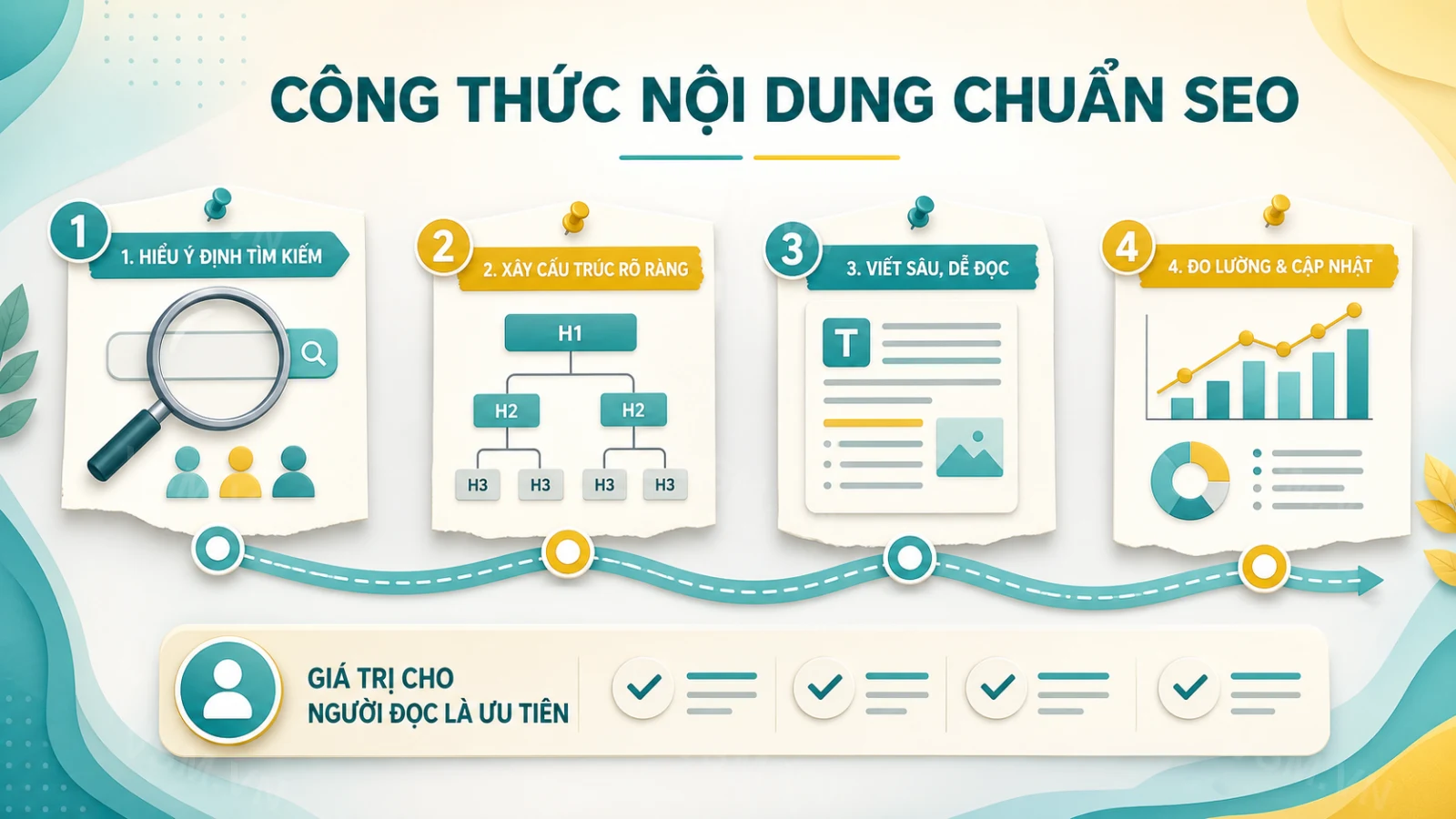
In today's fiercely competitive content landscape, writing SEO-optimized content that ranks on Google is no longer a nice-to-have skill — it has become essential for anyone who creates content, runs an online business, or manages a website. No matter how much effort goes into an article, if it isn't optimized the right way, it can easily get buried among millions of search results. Meanwhile, a well-structured, properly optimized post can bring in thousands of organic visits every month without spending an extra cent on advertising.
This guide walks you through the fundamentals: how to research keywords, build a solid content structure, optimize your copy, and avoid the common mistakes that keep articles from ever reaching page one — giving you a clear process you can apply to your own website right away.
What Does "SEO-Optimized Content" Actually Mean?
SEO-optimized content is writing that meets a reader's actual search need while also satisfying the criteria search engines — Google above all — use to evaluate and rank a page. In other words, a properly optimized article has to hit two targets at once: genuine usefulness for the reader and easy comprehension for the algorithm.
Many people still assume SEO simply means stuffing in as many keywords as possible, but Google has grown far smarter than that. It increasingly favors natural, in-depth content that genuinely solves the problem a user is searching for. That's why writing SEO content today means blending on-page optimization technique with real content quality — the two can no longer be treated as separate tasks.
The Dual Imperative: User Experience & Search Engine Signals
To truly understand SEO-optimized content, it's crucial to appreciate this dual imperative. On one hand, you have human users with specific questions, problems, or curiosities. They expect clear answers, easy navigation, and engaging content. If your article provides a poor user experience—if it's hard to read, irrelevant, or simply unhelpful—users will bounce, signaling to Google that your content isn't meeting their needs. Google's algorithms are constantly refined to detect these user signals.
On the other hand, search engines like Google use complex algorithms to crawl, index, and rank billions of web pages. These algorithms look for specific signals: keyword relevance, content structure, page loading speed, mobile-friendliness, internal and external links, and the overall authority and trustworthiness of your site. While these signals are technical, their ultimate goal is to identify content that provides the best possible answer to a user's query. Therefore, "SEO-optimized" means creating content that is both technically sound for crawlers and genuinely valuable for human readers.
Research Your Keywords Before You Start Writing
The first and most important step before writing anything is identifying your target keyword. This tells you exactly what people are typing into the search box, so you can write to their actual need instead of guessing.
- Pick one primary keyword that represents the article's topic — it should appear in the title and the opening paragraph.
- Add three to five secondary or LSI (latent semantic indexing) keywords so the article fully covers the topic's context and search intent.
- Analyze search intent: is the reader looking for information, comparing options, ready to buy, or just browsing? Let that shape your tone and format.
- Scan the current top 10 results for that keyword to see how competitors are covering it — and spot the angle they're missing that you can add.
Free tools like Google Keyword Planner and Google Trends work well here, or simply type the keyword into the search box and check the autocomplete suggestions and the "People also ask" box for more content ideas.
Understanding Different Types of Search Intent
Search intent is the "why" behind a search query. Ignoring it is one of the biggest mistakes content creators make. There are typically four main types of search intent:
- Informational: Users are looking for information, answers to questions, or general knowledge. Examples: "how to bake sourdough," "history of the internet," "what is photosynthesis." For these, long-form guides, tutorials, and explainer articles work best.
- Navigational: Users are trying to find a specific website or page. Examples: "Facebook login," "Amazon customer service," "Nike official website." For these, your brand's homepage or specific product/service pages are usually the target.
- Transactional: Users are ready to make a purchase or complete an action. Examples: "buy running shoes online," "best CRM software price," "download free ebook." Product pages, service pages, and e-commerce listings are ideal here.
- Commercial Investigation: Users are researching products or services before making a purchase. They're comparing options, looking for reviews, or seeking recommendations. Examples: "best laptop for graphic design," "iPhone 15 vs. Samsung S24," "CRM software reviews." Comparison articles, "best of" lists, and in-depth product reviews are great for this intent.
When you research your primary keyword, always ask yourself: "What does someone typing this into Google actually want to achieve?" Your content should directly address that goal.
Advanced Keyword Research Techniques
Beyond the basics, several advanced techniques can refine your keyword strategy:
- Competitor Keyword Analysis: Use tools like Ahrefs, SEMrush, or Moz to see what keywords your top-ranking competitors are targeting. This can reveal opportunities you missed or confirm the viability of your chosen keywords.
- Long-Tail Keywords: These are longer, more specific phrases (e.g., "best budget noise-cancelling headphones for travel"). While they have lower search volume, they often have higher conversion rates because the user's intent is very clear, and competition is usually lower.
- Question-Based Keywords: Focus on "who, what, where, when, why, how" questions related to your topic. Tools like AnswerThePublic can help visualize these questions, which are excellent for "People Also Ask" sections and direct blog posts.
- Keyword Gap Analysis: Identify keywords your competitors rank for, but you don't. This can reveal content gaps in your strategy that you can fill.
Remember, keyword research isn't a one-time task. The search landscape evolves, so revisiting your keywords periodically is crucial.
Build a Solid Structure for Your SEO Article
A clear structure helps both readers and search engines grasp your content quickly. A well-optimized article typically opens by framing the problem, develops each point in the body, and closes with a summary and a call to action.
Optimize Your Title and Meta Tags
The title should contain your primary keyword and run around 55-60 characters so Google doesn't truncate it in search results. The meta description should run about 150-160 characters, written to be compelling and to spell out a concrete benefit — it won't directly affect ranking, but it does drive up click-through rate (CTR).
Crafting Compelling Titles (Title Tags)
Your title tag is your article's first impression in the search results. It needs to be precise and inviting. Here are some tips:
- Include the Primary Keyword: Place it as close to the beginning as possible.
- Be Descriptive: Clearly tell users what the page is about.
- Incorporate Power Words: Words like "ultimate," "guide," "proven," "expert," "simple," "free," "best," "new," "fast," "easy" can boost appeal.
- Add Numbers: "7 Ways to Improve Your SEO" or "The 2024 Guide to Keyword Research" often perform well.
- Keep it Concise: Aim for 50-60 characters to avoid truncation. Use a title tag preview tool if unsure.
- Reflect Search Intent: Ensure the title accurately represents what the user will find on the page.
Example: Instead of "SEO Tips," try "10 Proven SEO Tips for Beginners to Rank Higher in 2024."
Writing Effective Meta Descriptions
While not a direct ranking factor, a well-written meta description is vital for attracting clicks. Think of it as a mini-advertisement for your content.
- Summarize the Content: Give a clear, concise overview of what the article covers.
- Include the Primary Keyword: While it doesn't rank, Google often bolds the search query in the description, making your result stand out.
- Highlight Benefits: What will the reader gain by clicking? "Learn how to save time," "Discover hidden strategies."
- Add a Call to Action (CTA): Phrases like "Learn more," "Find out how," "Get started today" can encourage clicks.
- Maintain Length: Keep it between 150-160 characters for optimal display on most devices.
Example: For an article on SEO tips, a meta description could be: "Unlock 10 proven SEO tips for beginners to boost your website's ranking in 2024. Learn actionable strategies to drive organic traffic and improve visibility."
Organize H2 and H3 Headings Logically
Aim for four to six H2 headings, each covering one main point, with H3s underneath to break things down further where needed. A clear heading hierarchy doesn't just make an article easier to scan — it also helps Google understand the page's structure and how relevant each section is to the search query.
Best Practices for Heading Structure
Headings are crucial for readability and SEO. They act like a table of contents for your article. Here's how to use them effectively:
- H1: The Main Title: There should only be one H1 tag per page, and it should contain your primary keyword. This is typically your article's main title.
- H2: Major Sections: Use H2s to break your content into main topics or chapters. Each H2 should ideally cover a distinct aspect of your primary keyword or a secondary keyword. For example, if your article is about "healthy breakfast ideas," H2s could be "Quick Breakfasts," "High-Protein Options," "Vegetarian Breakfasts."
- H3: Sub-Sections: Use H3s to further break down the content within an H2 section. For instance, under "Quick Breakfasts," H3s could be "Overnight Oats," "Smoothie Recipes," "Avocado Toast Variations."
- Logical Flow: Ensure your headings follow a logical progression, guiding the reader through the content smoothly.
- Keyword Integration: Naturally integrate secondary keywords into your H2 and H3 headings where appropriate, but never force them.
- Readability: Headings should be clear, concise, and entice the reader to continue.
Think of your article as an outline: H1 is the main topic, H2s are the main points, and H3s are sub-points. This hierarchical structure is not just good for SEO; it's excellent for user experience.
Optimize Content and Reader Experience
Content quality determines whether an article holds its ranking long-term, since Google increasingly weighs E-E-A-T: Experience, Expertise, Authoritativeness, and Trustworthiness. A properly optimized article should check the following boxes:
- Length that fits the topic — usually 1,000+ words for subjects that need in-depth explanation, without padding just to hit a word count at the expense of real value.
- Short paragraphs and plain language, avoiding jargon unless it's genuinely necessary.
- Images with descriptive alt text, which helps with image search and supports users relying on screen readers.
- Internal links pointing to related articles or service pages, helping Google understand how your pages relate to each other and keeping readers on your site longer.
- External links to credible sources whenever you cite data, which helps build the article's trustworthiness.
In practice, researching keywords, building structure, earning backlinks, and tracking rankings all at once takes considerable time and experience. If you don't have the internal resources to run this whole process yourself, consider working with a professional SEO service so an experienced team can handle everything from keyword research to on-page optimization and safe, structured link building.
Delving Deeper into E-E-A-T (Experience, Expertise, Authoritativeness, Trustworthiness)
Google's E-E-A-T guidelines are paramount, especially for "Your Money or Your Life" (YMYL) topics (e.g., health, finance, safety). E-E-A-T is not a direct ranking factor in itself, but it underpins many of the quality signals Google uses. Here's a breakdown:
- Experience: Does the content creator have firsthand experience with the topic? For example, a review of a software product written by someone who has actually used it extensively carries more weight than one written purely from secondary research. Demonstrating personal experience makes content more relatable and trustworthy.
- Expertise: Is the content created by someone knowledgeable in the field? This could be demonstrated through credentials, years of experience, or a deep understanding of complex subjects. For medical advice, a doctor's input is crucial; for legal advice, a lawyer's.
- Authoritativeness: Is the creator or website recognized as a go-to source for the topic? This is often built through consistent high-quality content, mentions from other authoritative sites, and a strong online reputation. Think of well-known industry leaders or established news outlets.
- Trustworthiness: Is the information accurate, honest, and safe? This is perhaps the most critical. It involves clear privacy policies, secure websites (HTTPS), transparent sourcing, and a lack of misleading or harmful content. Users need to feel safe consuming your content.
To showcase E-E-A-T, include author bios, link to reputable sources, cite studies, and ensure your content is factually correct and up-to-date. For YMYL topics, consider having content reviewed by subject matter experts.
The Role of Content Length and Depth
While there's no magic word count, the goal is to cover the topic comprehensively. If a topic can be fully explained in 500 words, don't stretch it to 2000. However, for complex subjects that require detailed explanations, examples, and multiple perspectives, longer content (1,500-3,000+ words) often performs better because it has the potential to:
- Answer more questions: More content means more opportunities to address various facets of a user's query and related questions.
- Include more keywords: Naturally integrate primary, secondary, and long-tail keywords without stuffing.
- Attract more backlinks: Comprehensive, authoritative content is more likely to be cited and linked to by other websites.
- Signal expertise: In-depth content demonstrates a deep understanding of the subject, boosting E-E-A-T.
Always prioritize value over sheer volume. Every sentence should contribute to the reader's understanding.
Optimizing Visuals: Images, Videos, and Infographics
Visuals enhance reader experience and offer additional SEO opportunities:
- High-Quality Images: Use relevant, high-resolution images that break up text and illustrate points.
- Descriptive Alt Text: This is crucial. Alt text describes the image for visually impaired users and search engines. It should be concise and include relevant keywords where natural. For example, instead of
<img src="pic1.jpg" alt="picture">, use<img src="sourdough-bread.jpg" alt="Freshly baked artisan sourdough bread with crispy crust">. - Image File Names: Use descriptive, keyword-rich file names (e.g.,
seo-content-structure.jpginstead ofIMG_001.jpg). - Image Compression: Large image files slow down page load times, which negatively impacts SEO. Compress images without sacrificing quality using tools like TinyPNG or ShortPixel.
- Videos: Embed relevant videos (from YouTube or your own server) to increase dwell time and provide information in an alternative format. Optimize video titles, descriptions, and tags.
- Infographics: These are highly shareable and can convey complex information visually, attracting backlinks and social shares.
The Power of Internal and External Linking
Links are the highways of the internet, guiding both users and search engine crawlers. Their strategic use is vital:
- Internal Links:
- Purpose: Connect related content on your own website. This helps Google understand the hierarchy and relationships between your pages, distributing "link equity" throughout your site. It also keeps users engaged on your site longer, reducing bounce rate.
- Best Practices: Link to older, relevant articles from new ones. Use descriptive anchor text (the clickable text) that includes keywords, but avoid keyword stuffing. For example, instead of "click here," use "learn more about comprehensive SEO strategies."
- Quantity: Don't overdo it, but aim for a natural sprinkling of 3-5 internal links for every 1000 words of content.
- External Links (Outbound Links):
- Purpose: Link to authoritative, high-quality external resources to back up your claims, provide further reading, and demonstrate trustworthiness and thorough research (E-E-A-T).
- Best Practices: Only link to reputable sources (e.g., academic studies, government websites, well-known industry publications). Ensure the links open in a new tab (
target="_blank") so users don't leave your site entirely. - NoFollow vs. Dofollow: By default, links are "dofollow," passing link equity. Use "nofollow" (
rel="nofollow") for sponsored content, untrusted sources, or user-generated content to prevent passing unintended authority.
Common Mistakes That Keep SEO Articles From Ranking
Plenty of articles never make it to page one despite the effort poured into them, because of a few recurring mistakes:
- Keyword stuffing, which makes sentences read awkwardly and can even get flagged as spam by Google.
- Copying or rehashing content from other sources without adding a genuine perspective or value, resulting in duplicate content.
- Ignoring the mobile experience, even though most searches today happen on a phone.
- Never updating older articles, letting information go stale and gradually lose ranking over time.
- Missing internal and external links, which turns an article into an isolated island that Google struggles to judge as relevant.
Elaborating on Duplicate Content and Lack of Originality
Google's primary goal is to provide users with the best, most relevant results. If your content is merely a rehash of what's already out there, it offers no unique value. Google's algorithms are sophisticated enough to detect content that is too similar to existing pages, which can lead to:
- Lower Rankings: Google won't prioritize your content if it doesn't stand out.
- Wasted Crawl Budget: Googlebot might spend time crawling duplicate content instead of your unique, valuable pages.
- Penalties (in extreme cases): While less common for unintentional duplication, deliberate copying can lead to manual penalties.
To avoid this, always strive for a unique angle, add personal insights, conduct original research, include case studies, or present information in a fresh, engaging way. Even if the topic is well-covered, your voice and perspective can make it unique.
The Critical Importance of Mobile-Friendliness
Google officially switched to mobile-first indexing in 2018, meaning it primarily uses the mobile version of your content for indexing and ranking. Ignoring mobile optimization is akin to ignoring SEO altogether.
- Responsive Design: Your website should adapt seamlessly to different screen sizes (phones, tablets, desktops).
- Fast Load Times: Mobile users expect pages to load almost instantly. Optimize images, leverage browser caching, and minimize code.
- Easy Navigation: Menus and buttons should be easily tappable with a thumb. Text should be legible without pinching and zooming.
- No Intrusive Interstitials: Pop-ups that cover the entire screen on mobile can be penalized by Google.
Use Google's Mobile-Friendly Test and PageSpeed Insights to check your site's performance.
The Neglect of Content Updates and Freshness
SEO is not a "set it and forget it" strategy. Information becomes outdated, statistics change, and competitors improve their content. Regularly updating your articles signals to Google that your content is current and relevant.
Actionable Tips for Content Updates:
- Audit Your Content: Periodically review your top-performing and underperforming articles.
- Update Statistics and Dates: Replace old data with new, and update years in titles (e.g., "Best SEO Strategies 2023" to "2024").
- Add New Information: If new developments have occurred in the topic, incorporate them.
- Improve Readability: Break up long paragraphs, add new headings, or incorporate more visuals.
- Refresh Keywords: Re-evaluate keyword performance and integrate new relevant keywords.
- Strengthen Internal Links: Link to newer, relevant content and remove broken links.
- Add a "Last Updated" Date: This reassures users that the information is current.
These updates can often lead to significant ranking boosts for existing content, which is more efficient than constantly creating new articles from scratch.
Pair Great SEO Writing With a Broader Strategy
Writing one strong, well-optimized article is a necessary step, but sustainable website growth depends on placing it inside a complete SEO strategy that combines technical work, content, and link building. If you're just starting out and want the full picture of what an SEO professional actually does, take a look at this overview of a comprehensive SEO strategy before you dive into writing individual posts.
Beyond that, keep tracking keyword rankings after publishing using Google Search Console, then adjust and expand your content periodically. SEO isn't a one-and-done task — it's a continuous optimization process driven by real data and users' ever-changing search behavior.
The Interplay of Technical SEO, Content, and Link Building
A truly successful SEO strategy integrates three core pillars:
- Technical SEO: This ensures your website's foundation is solid. It involves optimizing site speed, ensuring mobile-friendliness, setting up proper sitemaps and robots.txt files, fixing crawl errors, implementing schema markup, and ensuring HTTPS security. Without a technically sound site, even the best content might struggle to rank.
- Content SEO: This is what we've largely discussed – keyword research, on-page optimization, E-E-A-T, and creating high-quality, relevant content that genuinely serves user intent. Content is the fuel for your SEO engine.
- Off-Page SEO (Link Building): This involves acquiring high-quality backlinks from other reputable websites. Backlinks act as "votes of confidence" from other sites, signaling to Google that your content is valuable and authoritative. Strategies include guest posting, broken link building, creating shareable content (like infographics), and digital PR.
All three pillars must work in harmony. A beautiful car (content) won't go far without an engine (technical SEO) and fuel (link building). Neglecting any one area will limit your overall SEO potential.
Leveraging Google Search Console and Analytics for Continuous Improvement
Publishing content is just the beginning. The real work involves monitoring its performance and making data-driven adjustments.
- Google Search Console (GSC): This free tool from Google is indispensable.
- Performance Report: See which keywords your pages rank for, their average position, click-through rate, and impressions. Identify pages losing rank or keywords with high impressions but low CTR (suggesting title/meta description optimization).
- Coverage Report: Identify indexing issues, crawl errors, or pages that are not being indexed.
- Core Web Vitals: Monitor your page experience metrics (loading, interactivity, visual stability) which are ranking factors.
- Sitemaps: Submit your sitemap to help Google discover all your important pages.
- Google Analytics (GA4): While GSC focuses on how your site performs in search, GA4 shows what users do once they land on your site.
- Engagement: Track metrics like average engagement time, bounce rate, and pages per session to understand user behavior.
- Traffic Sources: Identify where your traffic is coming from (organic search, social, direct, referral).
- Conversions: Set up goals to track how many users complete desired actions (e.g., newsletter sign-ups, purchases).
By regularly analyzing data from GSC and GA4, you can identify opportunities to improve existing content, discover new keyword ideas, fix technical issues, and refine your overall content strategy. This iterative process is what drives long-term SEO success.
Frequently Asked Questions
How many keywords does an SEO-optimized article actually need? There's no fixed number, but as a rule of thumb an article should focus on one primary keyword plus three to five related secondary keywords, appearing naturally in the title, the opening paragraph, the headings, and spread throughout the body without feeling forced.
How long does it take for an SEO article to rank on Google after publishing? On average, a new article takes anywhere from 2 to 6 months to reach a stable ranking, depending on how competitive the keyword is, how authoritative the website is, and how much investment goes into links and related content around that article.
Do I need to hire a professional SEO service right from the start? If you have the time to learn and the patience to stick with it, you can absolutely learn and execute this yourself. That said, if you need faster results, technically sound execution, and want to save time, a professional SEO agency can significantly shorten the path to ranking.
Does an SEO-optimized article have to be long? Not necessarily. Length should match how complex the topic is and what the reader is searching for — what matters most is that the content fully resolves the problem the reader actually cares about.
Q: What is the most important factor for ranking on Google? A: While many factors contribute, the most important is creating high-quality, relevant content that genuinely satisfies user search intent. Google prioritizes content that provides the best answer or solution to a user's query, backed by strong E-E-A-T signals and a solid technical foundation.
Q: Should I worry about keyword density? A: Keyword density is largely an outdated metric. Instead of focusing on a specific percentage, concentrate on naturally integrating your primary and secondary keywords throughout the content. Over-optimization (keyword stuffing) can harm your rankings, so prioritize natural language and readability above all else.