
Is a Google Map 5-Star Review Service Safe? The Truth & What to Know
Vietnamese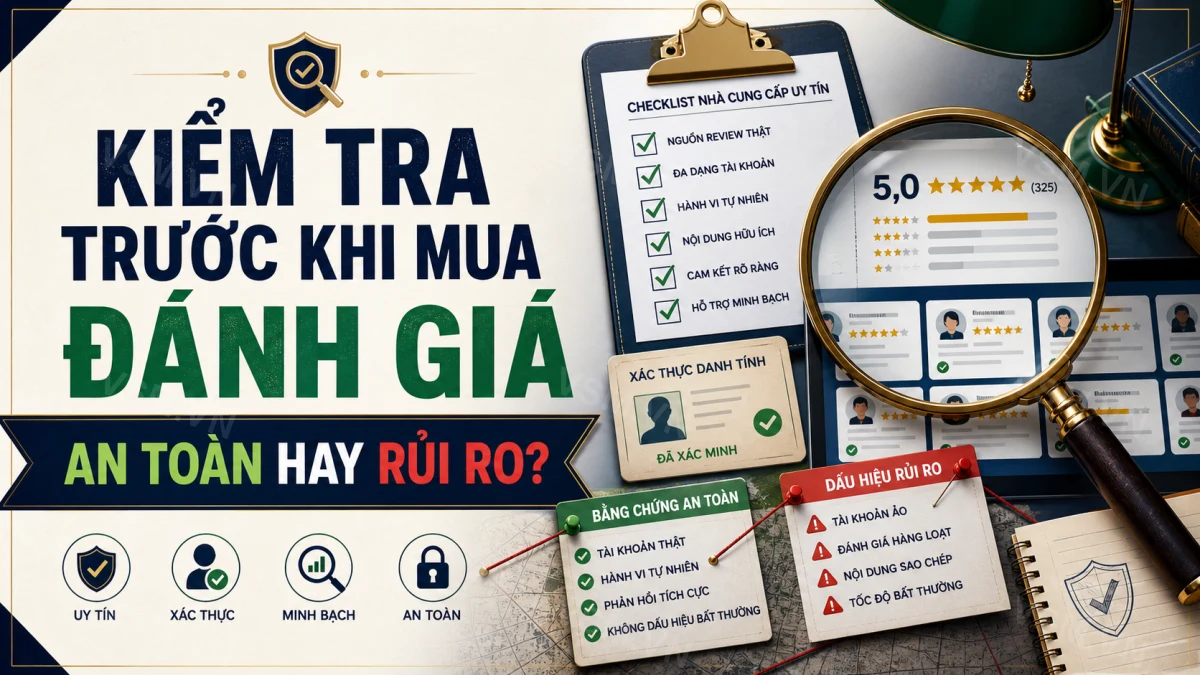
Quick answer: Generally, a Google Maps 5-star review service isn't inherently "safe" if it involves purchasing fake reviews. Google's algorithms are increasingly sophisticated, and purchased reviews often lack genuine user content, making them detectable. While some services claim to use "real" accounts, the practice violates Google's policies and risks penalties like review removal or even business profile suspension, which can take months to resolve. Focus on organic growth and excellent customer service for lasting positive impact.
Five-star reviews on Google Maps directly influence a customer's decision to pick one business over another, especially in industries like F&B, spas, dental clinics, auto repair, and beauty salons. Because the payoff is so clear, more and more business owners are turning to a Google Map 5-star review service to quickly boost their rating and review count, rather than waiting for customers to leave feedback on their own. But the question that still makes many hesitate is this: could using such a service get you penalized by Google, and is it actually safe for your business profile?
This article takes an honest look at how Google Map review services actually work, the real risks of choosing the wrong provider, and how to recognize a trustworthy service that grows your reviews while keeping your Google business profile safe.
What Is a Google Map 5-Star Review Service?
Put simply, this is a service that helps businesses gain additional reviews at the desired star rating on their Google Business Profile (formerly Google My Business). Providers typically work in a few ways: mobilizing collaborators who genuinely try the business and then leave a review, building a network of aged Google accounts with a real activity history to post reviews on the business's behalf, or combining both approaches with varied content scripts to avoid repetitive wording.
The ultimate goal isn't just an attractive average star rating — it's also about helping the listing appear more prominently in the "local pack," the three map results shown at the top of the search page when someone searches a keyword together with a location, bringing in more potential customers without having to run ads nonstop.
How Review Services Operate: A Closer Look
To understand the safety of these services, it's crucial to grasp their operational mechanics. A high-quality service often employs a multi-faceted approach:
- Genuine User Networks: Some services partner with a network of real individuals who are paid to visit and genuinely experience a business. These users then leave authentic reviews based on their experience, mimicking organic customer behavior. This method is generally considered the safest but also the most resource-intensive and expensive.
- Aged Account Networks: Other services utilize a network of aged Google accounts. These aren't newly created profiles; they are accounts that have a history of activity, including leaving reviews for other businesses, searching for locations, and interacting with Google services over a long period. This historical activity makes the reviews appear more natural to Google's algorithms.
- Content Diversification: A key aspect of a reputable service is the ability to generate diverse and unique review content. They avoid using boilerplate templates or repeating phrases. Instead, they often gather specific details about your business, products, or services to craft varied and authentic-sounding feedback.
- Geographic and Temporal Spacing: To further mimic organic growth, trustworthy services will space out reviews geographically and temporally. This means reviews won't all come from the same IP address or location, nor will they all appear on the same day. This gradual, distributed approach is critical for evading Google's detection systems.
Understanding these methods helps businesses differentiate between a legitimate service and a risky, black-hat operation.
Why Do Businesses Need 5-Star Reviews on Google Maps?
Most users read at least a few reviews before deciding to visit a new place, and they tend to skip over businesses rated below 4 stars or with too few reviews to go by. That's why the quantity and quality of reviews directly affect three core aspects:
- Higher conversion rates: customers trust the business more and decide to visit, call, or book faster when they see plenty of positive feedback.
- Better local SEO rankings: Google favors showing listings with more reviews, a higher average rating, and frequent updates.
- Stronger brand credibility: a profile with hundreds of 5-star reviews signals that this is a place many people genuinely choose and are happy with.
For newly opened businesses, the early stage usually lacks organic reviews simply because there aren't many customers yet, leaving the profile looking "empty" next to competitors that have been running for years. That's why many shop and restaurant owners consider a review support service an initial push to get things started.
The Psychology Behind Google Reviews
Beyond the technical aspects, there's a strong psychological component to why reviews are so powerful. This is often referred to as "social proof." When potential customers see that many others have had positive experiences with a business, it creates a sense of trust and reduces perceived risk. This is especially true for services that involve personal trust, like dental work, or significant financial investment, like auto repair.
- Risk Reduction: Customers are inherently risk-averse. A high number of positive reviews acts as a collective endorsement, signaling that the business is reliable and delivers on its promises.
- Decision Fatigue: In a world with countless choices, reviews simplify the decision-making process. A quick glance at a 4.5+ star rating with hundreds of reviews can be enough for a customer to choose your business over a competitor with fewer or lower ratings, even if your actual offerings are similar.
- Emotional Connection: Well-written, authentic reviews can evoke an emotional response, painting a vivid picture of the customer experience. This can be more compelling than any marketing copy.
For a new restaurant, imagine a customer searching for "best pizza near me." Two pizzerias appear in the local pack. One has 10 reviews with an average of 3.8 stars. The other has 150 reviews with an average of 4.7 stars. Even if the first pizzeria has amazing pizza, the social proof for the second one is overwhelmingly stronger, making it the default choice for most users.
The Local SEO Advantage: Beyond Just Stars
While the star rating is crucial, Google's local search algorithm considers several other factors related to reviews:
- Review Quantity: A higher number of reviews suggests a popular and active business.
- Review Velocity: The rate at which new reviews are acquired. A steady stream of new reviews signals an ongoing positive customer experience.
- Review Diversity: Reviews that mention different aspects of your business (e.g., "friendly staff," "great coffee," "clean restrooms") can help Google understand the breadth of your offerings and match your business to more specific search queries.
- Keyword Mentions: When customers naturally include keywords related to your products or services in their reviews, it can boost your relevance for those terms in local searches. For example, a review saying "best gluten-free bakery in town" directly helps the bakery rank for "gluten-free bakery."
- Review Responses: Google also looks at how businesses interact with their reviews. Responding to both positive and negative feedback shows engagement and customer care, which can positively influence rankings.
These elements combined create a robust signal to Google that your business is not only reputable but also relevant and actively engaging with its customer base, leading to improved visibility in the coveted local pack.
Is a Google Map Review Service Safe? The Truth You Need to Know
The honest answer is: how safe it is depends entirely on how it's carried out. It's neither true that "using a service always gets you penalized" nor that "using a service is completely risk-free." Google runs algorithms designed to detect unusual review behavior, such as a batch of reviews appearing all at once, newly created accounts with no activity history, review content that repeats the same template, or reviews clustered from the same server IP range.
Risks of Using a Low-Quality Service
If you pick the wrong provider — one that pumps out large volumes using software or fake accounts — your business could face the following consequences:
- Reviews get flagged and removed by Google within days to weeks, causing your rating to drop suddenly and your money to go to waste.
- Your business profile gets flagged as suspicious, with limited visibility or temporary removal from map search results.
- In more serious cases, the profile can be suspended altogether, forcing you to file an appeal and re-verify from scratch — disrupting your business.
These penalties are not just theoretical; many businesses have experienced them. Imagine investing heavily in a service, only to see all the reviews disappear overnight, leaving your profile worse off than before, potentially with a "reviews removed" flag that deters future customers. A suspended profile means your business effectively disappears from Google Maps and local search results, a catastrophic outcome for any local business relying on foot traffic or local inquiries.
What Makes a Review Service Trustworthy and Safe
By contrast, a well-run service keeps risk to a minimum by following a few key principles: growing reviews at a natural pace, spread out day by day rather than dumped all at once; using genuine Google accounts with a real activity history; varying the content instead of copying a single template; and never promising a "lifetime guarantee," since Google always retains the right to review any listing at any time. If you're looking for a provider that follows proper standards, with natural content scripts and a reasonable delivery pace, you may want to check out VSM's Google Map 5-Star Review Service, currently used across industries such as F&B, beauty, education, and repair services.
Google's Algorithm: How It Detects "Fake" Reviews
Google employs sophisticated machine learning algorithms to identify and remove reviews that violate its policies. These algorithms look for patterns and anomalies, including:
- IP Address Clustering: Multiple reviews originating from the same or closely related IP addresses within a short period.
- Account Age and Activity: Reviews from newly created Google accounts with no prior activity, or accounts that only review one specific business.
- Review Content Repetition: Identical or highly similar phrases, keywords, or grammatical structures across multiple reviews.
- Unnatural Review Velocity: A sudden spike in reviews, especially for a business that previously had very few or no reviews.
- Geographic Discrepancy: Reviews from accounts that are geographically distant or inconsistent with the business's typical customer base.
- Negative Sentiment Flags: Reviews that are overtly promotional, irrelevant, or contain spammy links. While a 5-star service focuses on positive reviews, it's worth noting that Google also flags artificially negative reviews from competitors.
Understanding these detection methods is crucial for both businesses and service providers. A reputable service actively works to circumvent these flags by mimicking organic user behavior, making their operations significantly safer and more sustainable.
How to Choose a Trustworthy Google Map Review Service and Avoid Wasting Money
Before partnering with any provider, businesses should carefully check the following criteria to avoid a costly mistake:
- A clear commitment on the retention rate of reviews after a set period (e.g., 30-60 days), rather than just a verbal promise.
- The option to choose the delivery speed — how many reviews per day — to match the actual scale of your business.
- A support channel with transparent progress reporting, not one that goes silent after payment is received.
- No request for your Google Business Profile admin password — a reputable service only needs the public address and profile name to get started.
- Pricing that's reasonable compared to the market average; unusually cheap prices are often a sign of low-quality accounts that Google is quick to sweep away.
It also helps to pair a support service with genuine efforts to encourage real customers to leave reviews — through a QR code at the counter or a thank-you message after purchase — which makes the profile look more natural and sustainable in the long run.
Actionable Tips for Vetting a Review Service
To further protect your investment and business, consider these additional steps when evaluating a potential provider:
- Ask for Case Studies or Testimonials: A reputable service should be able to provide examples of businesses they've helped and potentially connect you with references. Look for long-term clients who have seen sustained results.
- Understand Their Process: Don't be afraid to ask detailed questions about how they source reviews, how they ensure content originality, and what measures they take to avoid Google's detection. A transparent provider will be happy to explain their methods.
- Check Their Online Presence: Do they have a professional website? Are there reviews for their own service? While not foolproof, a strong online presence can indicate legitimacy.
- Start Small: If you're unsure, begin with a smaller package to test their service. Monitor the results closely for a month or two before committing to a larger order. This allows you to assess the quality and retention rate firsthand.
- Read the Fine Print: Pay attention to any guarantees or refund policies. Be wary of providers offering "lifetime guarantees" on reviews, as Google's policies can change, and no service can truly guarantee indefinite retention. A more realistic commitment is a retention rate for a specified period (e.g., 60-90 days).
- Avoid Services Demanding Full Upfront Payment for Large Orders: While some deposit is standard, be cautious if a service insists on full payment for a massive order without any staggered payment options, especially for new clients.
Integrating Paid Reviews with Organic Review Generation
The most effective strategy is a hybrid approach. While a support service can provide an initial boost or fill gaps, fostering organic reviews is vital for long-term sustainability. Here’s how to integrate them:
- In-Store Prompts: Place "Review Us on Google" signs with QR codes at your checkout counter, tables, or waiting areas.
- Post-Service Follow-up: Send a polite email or SMS after a customer's visit or purchase, asking for their feedback and including a direct link to your Google Business Profile review page.
- Staff Training: Encourage your employees to politely ask satisfied customers for reviews. A personal request can be very effective.
- Respond to All Reviews: Engage with both positive and negative reviews. Thank customers for positive feedback and address negative comments professionally and constructively. This shows potential reviewers that you value their input.
- Offer Incentives (Carefully): Google's policies prohibit offering monetary incentives for reviews. However, you can offer non-monetary incentives for feedback in general (e.g., a chance to win a prize for filling out a survey), then subtly direct them to Google if they had a positive experience. Always ensure compliance with Google's guidelines.
By combining a strategic, safe review service with robust organic review generation efforts, businesses can build a powerful and authentic online reputation that drives sustained growth.
Comparison: Collecting Reviews Organically vs. Using a Support Service
Collecting reviews entirely organically from real customers is the safest approach in the long run, but the pace is usually very slow and depends on whether customers actively choose to leave feedback — in reality, even happy customers rarely take the time to write a review unless reminded at the right moment. A support service, on the other hand, can significantly shorten the time it takes to build initial credibility, which is especially useful for new businesses or ones that need to boost their rating quickly ahead of an ad campaign or a grand-opening event.
The principle of "grow naturally, don't dump a large volume in a short time" applies to nearly every platform, not just Google Maps. Much like learning how to buff Facebook likes safely and effectively, choosing an engagement service for Google Maps also means prioritizing a reasonable delivery pace and quality account sources instead of running massive volumes all at once, which helps you avoid detection and enforcement by the platform. The optimal approach is usually to combine both: use a service to build a solid initial review base while keeping up the habit of collecting genuine reviews from customers, so the profile keeps growing sustainably even after you stop using the service.
Scenarios Where a Review Service Shines
While organic reviews are the gold standard, there are specific situations where a well-chosen review service can provide critical support:
- New Business Launch: A brand-new business often struggles to get initial traction. A service can provide the foundational reviews needed to appear credible and attract first-time customers.
- Reputation Recovery: A business might suffer from a few unfairly negative reviews that drag down its overall rating. A judicious injection of positive reviews can help balance the scales and prevent long-term damage.
- Competitive Markets: In highly competitive industries (e.g., busy urban restaurants, specific medical clinics), having a superior review profile can be a significant differentiator.
- Pre-Campaign Boost: Before launching a major advertising campaign or a seasonal promotion, boosting review count and rating can maximize the impact of your marketing spend by ensuring potential customers see a strong reputation.
- Addressing "Review Gaps": Some businesses have many happy customers but struggle to convert them into online reviews. A service can help bridge this gap while the business implements better organic review collection strategies.
In these scenarios, the strategic use of a review service is not about deception but about leveling the playing field or accelerating growth in a way that organic methods alone cannot achieve in the short term.
The Long-Term View: Beyond the Initial Boost
It's vital to remember that a review service is a tool for acceleration, not a permanent solution for neglecting customer experience. Once you've achieved your desired review count and rating, the focus must shift back to maintaining that reputation through genuine customer satisfaction. Think of it as planting seeds: the service helps you plant many seeds quickly, but you still need to water and nurture them (i.e., provide excellent service) for them to grow into strong, lasting plants (organic reviews).
Businesses that rely solely on paid reviews without improving their core service will eventually see their reputation erode. Google's algorithms are constantly evolving, and customer expectations for authenticity are only increasing. Therefore, integrate any review service as part of a broader strategy that prioritizes customer satisfaction and encourages authentic feedback at every touchpoint.
Steps for a Sustainable Review Strategy
- Audit Your Current Situation: Understand your current review count, average rating, and typical review velocity. Identify areas for improvement in your customer experience.
- Set Realistic Goals: Determine how many reviews and what average rating you aim for within a specific timeframe.
- Choose a Reputable Service: Follow the guidelines outlined above to select a provider that emphasizes safety and natural growth.
- Implement Organic Collection Methods: Simultaneously, put in place strategies to encourage real customers to leave reviews (e.g., QR codes, email follow-ups, staff training).
- Monitor and Respond: Regularly check your Google Business Profile for new reviews. Respond promptly and professionally to all feedback.
- Analyze and Adapt: Periodically review your progress. Are the paid reviews sticking? Are organic reviews starting to pick up? Adjust your strategy as needed. If you notice a drop in reviews from the service, communicate with your provider immediately.
By taking this comprehensive approach, businesses can leverage the benefits of review services while building a robust, authentic, and sustainable online reputation.
Frequently Asked Questions
Can using a Google Map review service get my business profile suspended? The risk only arises when you use a low-quality service that pushes an unusually large volume of reviews in a short time using fake accounts. If you choose a reputable provider that delivers at a natural pace, the chance of your profile being suspended is very low.
How long does it take to see results after using the service? Reviews are typically posted gradually over a few days to a few weeks depending on the package, and the impact on local SEO rankings usually becomes noticeable after about 2-4 weeks, once both the review count and average rating have stabilized.
Should I buy a large batch of 5-star reviews in a single day to boost my rating fast? No, you shouldn't. This is exactly the kind of behavior Google detects most easily, so it's best to choose a package that spreads growth evenly over several days rather than dumping a large volume all at once.
Can I provide my own content guidelines so reviews match my brand's voice? Yes. Reputable services typically let businesses submit a set of keywords and product or service details in advance, so the review team can write natural content that matches your brand voice instead of copying a single template.
What if some reviews get removed by Google? Will the service replace them? A trustworthy service should have a clear retention guarantee and a replacement policy for reviews that are removed within a specified period (e.g., 30-90 days). Always confirm this policy before committing to a service.
Is it possible to get reviews from specific geographic areas or demographics? Some advanced, high-quality services may offer options for targeting reviews from certain geographical regions to further enhance authenticity, especially if your business serves a particular area. Demographic targeting is more challenging and less common for review services but can be discussed with providers.