
Factors That Determine the Cost of Comprehensive SEO Services
Vietnamese
Quick answer: The cost of comprehensive SEO services is primarily driven by the scope and complexity of the work. Factors include the number of keywords targeted, the competitive landscape of those keywords, and the extent of content creation and technical SEO required. For instance, a small local business might pay around $500-$1500 monthly for basic services, while a large e-commerce site targeting hundreds of keywords could easily exceed $5,000 per month due to the intensive strategy and ongoing optimization needed. The chosen agency's experience and location also play a role.
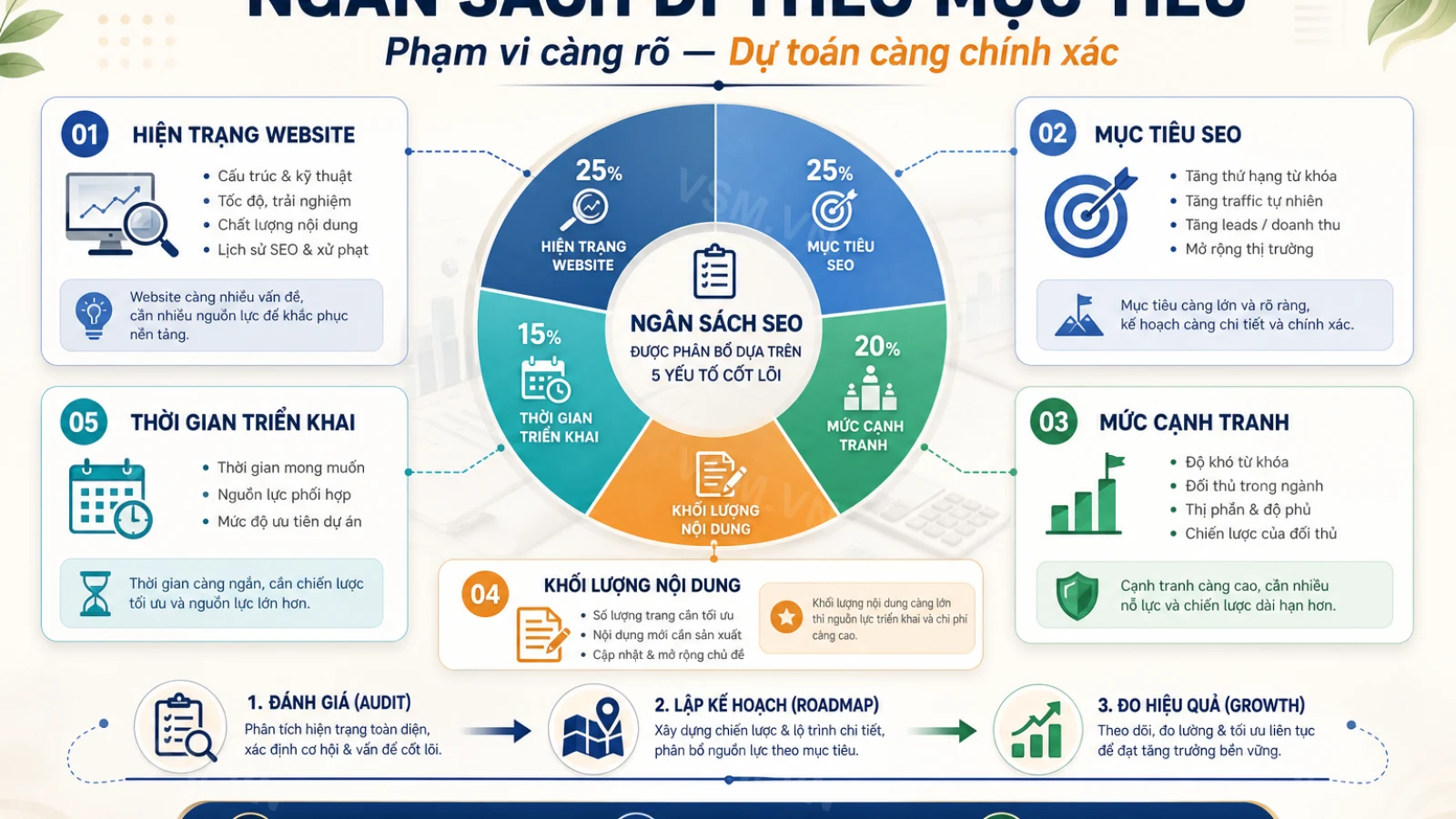
When researching SEO, many business owners ask the same question: how much do I need to spend each month to get my website ranking on Google? In reality, the cost of a comprehensive SEO service has no fixed number that applies to every case — it depends on a wide range of variables, from how competitive the industry is, to the current state of the website, to the capability of the agency delivering the work.
This article breaks down the key factors that shape the price of a comprehensive SEO campaign, helping you understand exactly what you're paying for and how to choose a service package that fits your budget and business goals.
What Is Comprehensive SEO, and Why Doesn't It Have a Fixed Price?
Comprehensive SEO is a holistic approach to optimizing a website — covering technical SEO, content, backlinks, and user experience — aimed at improving rankings for a broad set of industry-relevant keywords rather than just a handful of individual terms. If you're not yet clear on this concept, take a look at our overview of comprehensive SEO and what an SEO team actually does to get the full picture before we get into pricing.
Because the scope of work is so broad and depends on each website's actual condition, no agency can apply a single flat rate to every client. Two businesses in the same industry can receive quotes that differ several times over, depending on domain age, number of competitors, or growth targets.
Factors That Determine the Cost of a Comprehensive SEO Service
1. How Competitive the Industry and Keyword Group Are
This is the single biggest factor behind any quote. Industries with high order values and heavy SEO investment from competitors — real estate, finance, insurance, dentistry, law, and the like — typically require a much larger budget than less competitive fields. The higher the search volume and difficulty of a keyword, the more quality backlinks and content need to be produced, which drives costs up accordingly.
For example, ranking for "real estate investment" in a major city is far more challenging than "local bakery in Springfield." The former involves a larger volume of high-quality content, aggressive link-building strategies, and continuous optimization efforts to stay ahead of competitors.
2. The Website's Current State and Technical Workload
A new website that has never been optimized often carries multiple technical issues: slow load times, non-standard URL structures, missing structured data (schema), duplicate content, and so on. Fixing these issues takes time and technical manpower, which raises costs in the early stage. A website that already has a solid foundation and has been properly optimized before, on the other hand, will save significantly on audit and fix costs.
Consider a website with a robust framework and a history of on-page optimization. Such a site might only require periodic audits and minor tweaks, compared to a brand-new website needing a complete overhaul, which significantly impacts the pricing.
3. Scope of Work: Audit, Content, Backlinks, and Technical SEO
A full comprehensive SEO package typically covers four main workstreams:
- Technical audit and optimization: reviewing the entire site, fixing indexing issues, improving speed, and standardizing structure.
- Keyword research and content development: building a keyword set, writing SEO-optimized articles, and optimizing landing pages.
- Link building: acquiring quality backlinks from reputable sources to boost domain trust.
- Monthly tracking, reporting, and strategy adjustments based on real performance data.
If a business only needs one of these — say, content writing alone or a technical audit alone — the cost will be far lower than a full comprehensive SEO package covering all four areas.
For instance, if a company has a team capable of handling content creation in-house, they might opt to outsource only the technical SEO and link-building aspects, thus optimizing their budget effectively.
4. The Provider's Experience, Team, and Tools
An agency with dedicated specialists for each area (technical, content, link building, project management), paid keyword research and competitor analysis tools, and experience across multiple industries will typically quote higher than a small shop or freelancer. That said, a higher price usually comes with a more rigorous process, transparent reporting, and a better shot at sustainable results — reducing the risk of penalties from Google's algorithms.
For example, an experienced agency might offer advanced tools like SEMrush, Ahrefs, or Moz for comprehensive competitor analysis, which are instrumental in crafting effective strategies. Furthermore, their expertise can prevent costly mistakes, such as over-optimization or neglecting critical on-page elements.
5. Commitment Period and KPI Targets
SEO is a long-term strategy, generally taking 4 to 6 months to show clear results and 8 to 12 months to reach a stable position on page one. Packages that commit to specific KPIs — for example, a set number of keywords reaching the top 10 within a set number of months — tend to cost more than packages without such commitments, since the provider has to invest more resources to guarantee the outcome.
It's crucial for businesses to align their expectations with realistic timelines. For instance, if immediate results are needed, they might need to combine SEO with PPC campaigns, although this increases the overall marketing budget.
Common Price Ranges in the Market Today
In the Vietnamese market, comprehensive SEO service costs are typically split into three tiers:
- Basic package: suited to small websites in low-competition industries, focused on a limited set of keywords.
- Standard package: designed for mid-sized businesses that need comprehensive optimization across multiple keyword groups, with detailed periodic reporting.
- Premium package: built for highly competitive industries, requiring a specialized team, a large volume of content and backlinks, and clear KPI commitments.
Exact pricing can vary significantly between providers depending on how it's calculated — per keyword, per month, or as a fixed project package — so businesses should request a detailed quote with an itemized scope of work rather than comparing total figures alone.
For example, a basic package might start at $500 per month, while premium services can exceed $5000 monthly. Regardless of the choice, transparency in the deliverables and ongoing communication is crucial to ensure the investment aligns with business goals.
How to Optimize Your SEO Budget Without Sacrificing Results
To avoid wasting budget, keep the following principles in mind when choosing a service:
- Define your business goals clearly before choosing a package, and avoid spreading SEO efforts across too many keywords unrelated to your core product.
- Ask the provider to explain their methodology in detail, and be wary of unusually cheap packages, which may rely on black-hat SEO techniques that carry a real risk of Google penalties.
- Prioritize providers who report transparently using real data — rankings, traffic, conversion rate — rather than relying on verbal promises alone.
- Consider pairing SEO with social media engagement channels to strengthen social signals, helping content spread faster and indirectly supporting SEO.
If your business needs a partner to handle everything from audits and content development to link building on a clear roadmap, take a look at VSM's comprehensive SEO service, which offers transparent, itemized pricing and regular progress reports so you can easily track the return on your investment.
When Should a Business Choose an All-in-One SEO Package?
An all-in-one SEO package suits businesses that have already settled on SEO as a long-term marketing channel, have a stable monthly budget, and want everything — from technical work to content — optimized in sync without managing each piece separately. If budget is limited, or you only need to address one specific issue (say, site speed, or simply need extra content), it may make more sense to hire services by individual workstream to save on upfront cost, then expand once you start seeing results.
Additionally, businesses should consider the scalability of their SEO efforts. As they grow, their SEO needs might evolve, necessitating a shift from individual services to a comprehensive package that ensures cohesive strategy implementation and consistent brand messaging.
Evaluating the ROI of Your SEO Investment
Understanding the return on investment (ROI) for SEO is crucial for businesses to justify their marketing spend. While SEO doesn't yield immediate results like paid advertising, its long-term benefits can be substantial.
1. Measuring SEO Success
Metrics such as organic traffic growth, keyword rankings, and conversion rates are essential indicators of SEO success. Tools like Google Analytics and Google Search Console provide insights into these metrics, helping businesses assess the effectiveness of their SEO strategies.
For example, a business might notice a 30% increase in organic traffic after six months of consistent SEO efforts, translating into higher sales or leads.
2. Cost-Benefit Analysis
Conducting a cost-benefit analysis helps determine whether the investment in SEO is paying off. This involves comparing the cost of the SEO services against the revenue generated from organic search traffic.
Businesses should factor in both direct sales and brand visibility when assessing ROI. Enhanced brand visibility can lead to increased trust and credibility, indirectly boosting sales over time.
3. Long-Term Gains
Unlike short-term marketing tactics, SEO offers sustained benefits. Once a website ranks highly for competitive keywords, it can maintain those rankings with minimal ongoing effort, providing a continuous source of organic traffic.
This long-term gain is particularly valuable for businesses with evergreen products or services, ensuring a steady influx of potential customers without recurring high advertising costs.
Frequently Asked Questions
What does a comprehensive SEO service typically cost per month? The cost depends on the industry, keyword competitiveness, and scope of work, so there's no fixed figure that applies across the board. Businesses should request a website audit and a detailed, itemized quote to get an accurate number for their specific case.
How long does comprehensive SEO take to show results? It typically takes about 3 to 6 months to see a clear shift in rankings and traffic, and 8 to 12 months to reach a stable position on page one, depending on how competitive the industry is.
Why do some providers quote SEO prices far below the market average? Unusually low prices are often a sign of cut corners — reduced staffing, poorly supervised automation tools, or black-hat SEO techniques. These approaches can produce short-term results but carry a real risk of the website being penalized and losing rankings later on.
Should you choose an SEO package with a keyword-ranking guarantee? A KPI-guaranteed package can offer more peace of mind, but read the contract terms carefully — check which keywords are covered and how success is measured — to avoid a provider that only guarantees low-competition keywords with little real conversion value.
How can small businesses compete with larger companies in SEO? Small businesses can focus on niche keywords and local SEO strategies to compete effectively. By targeting less competitive, long-tail keywords and ensuring their Google My Business profile is optimized, they can attract relevant local traffic without the high costs associated with broader, competitive keywords.