
Traffic User vs Traffic Bot: Which One Is Safe for SEO?
Vietnamese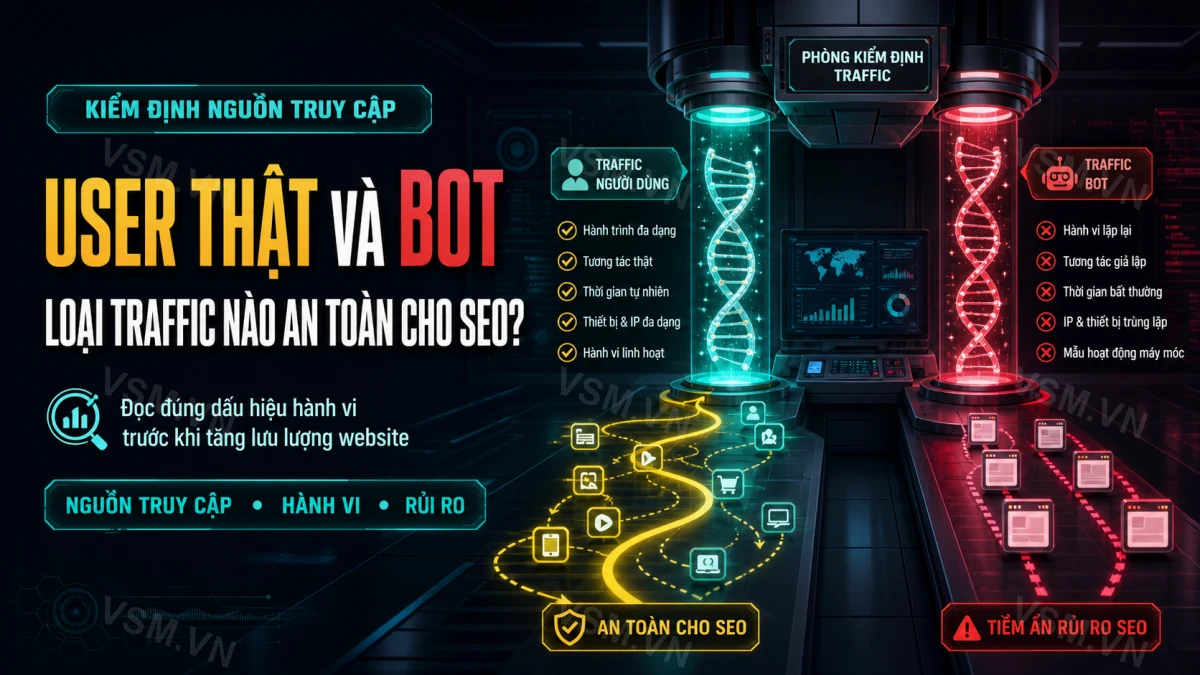
Quick answer: For SEO safety, traffic users are unequivocally safer than traffic bots. Google's algorithms, particularly after updates like Penguin 4.0 in 2016, heavily penalize sites with bot traffic, viewing it as manipulative. While some "safe" bots claim to mimic human behavior, they still carry inherent risks of detection and subsequent ranking drops. Prioritizing genuine human engagement, even if slower, offers long-term, sustainable SEO benefits without the constant threat of algorithmic penalties.
If you're looking for ways to increase traffic to your website, you've probably come across the terms traffic user and traffic bot. These are two fundamentally different types of traffic, yet they're often confused when businesses choose a service to boost website traffic. Understanding the real difference between traffic user vs traffic bot doesn't just help you optimize your marketing budget — it also helps you avoid the risk of Google devaluing your site, or even penalizing your rankings, because of fake, unnatural traffic.
In this article, VSM breaks down the true nature of each traffic type, how search engines detect them, and which type of traffic is genuinely safe and delivers long-term value for your SEO strategy.
What Is Traffic User?
Traffic user refers to visits from real people using an actual browser and device to access your website. When a real user lands on a page, they exhibit natural interactive behavior: moving the mouse, scrolling, pausing to read content, clicking internal links, and even filling out forms or leaving comments. This behavior is fully captured in Google Analytics and Search Console through metrics like time on page, pages per session, and bounce rate.
Real user traffic can come from a variety of sources: organic search, social media, referral links, direct visits, or professional traffic user services that simulate genuine human behavior to boost early engagement metrics for a new website — giving Google additional signals to evaluate and index content faster.
What Is Traffic Bot?
Traffic bot refers to visits generated by automated software, scripts, or emulation tools rather than an actual person sitting in front of a screen. Bot traffic typically shows several telltale signs: a bounce rate close to 100%, time on page at or near zero, no scrolling or clicking behavior, duplicate IPs or traffic clustered in an unusual IP range, and in many cases, an inability to execute the page's JavaScript.
It's important to distinguish between two categories of bots: beneficial bots like Googlebot and Bingbot, which crawl your site to support indexing, and malicious bots — mass-generated fake traffic designed to artificially inflate visitor numbers. This kind of traffic delivers no real value and carries hidden risks for both SEO and data security.
Traffic User vs Traffic Bot: Key Differences
To make the differences easier to visualize, here's a comparison of the two traffic types across several key criteria:
- Origin: traffic user comes from a real person's browser and device; traffic bot is generated by scripts, proxies, or emulation software running on a server.
- On-page behavior: traffic user scrolls, clicks, and reads content over a reasonable amount of time; traffic bot typically lands and exits almost instantly, with no genuine interaction.
- Analytics metrics: traffic user produces natural, varied data across session duration and pageviews; traffic bot spikes the bounce rate, drives time on page toward zero, and creates abnormal data clustered by time or IP.
- Impact on SEO: traffic user, especially traffic with natural behavior, supports positive signals for your website; traffic bot does nothing for rankings and can raise Google's suspicion of your data, skewing optimization decisions based on fabricated numbers.
- Cost and sustainability: traffic bot is usually cheap and fast to scale but unsustainable and risky; quality traffic user costs more but delivers long-term value and greater safety for your overall SEO strategy.
Why Can Google Detect Traffic Bot?
Google doesn't disclose the exact details of its algorithm, but after years of development, its systems can analyze a wide range of behavioral signals to tell real users apart from bots: dwell time, pogo-sticking (returning to the search results immediately after clicking a page), mouse-movement patterns, JavaScript execution capability, device fingerprinting, and the reputation of the visiting IP range.
It's worth noting that Google Analytics isn't a direct ranking data source. Even so, when large volumes of bot traffic flood a website, it causes two real problems: first, it distorts your analytics data, leading you to make the wrong optimization decisions; second, if that traffic deliberately fakes clicks on search results with abnormal behavior patterns, Google's anti-spam systems can flag your site as suspicious, indirectly damaging your domain's reputation over the long run.
Which Type of Traffic Is Safe for SEO?
As a general rule, the safest traffic is always traffic that comes from real users with genuine intent: organic search, quality referrals, or traffic from well-targeted social campaigns. This is the most sustainable foundation for any long-term SEO strategy.
For a new website that needs extra early-stage signals, or wants to improve engagement metrics to support faster indexing and content evaluation, many businesses choose a traffic user service instead of cheap traffic bot packages. If you're considering this route, take a look at VSM's traffic user service, where traffic simulates genuine human behavior with diverse IPs and devices and realistic on-site time, helping your website improve its metrics naturally instead of generating the abnormal numbers that anti-spam systems are quick to flag.
If you're not yet clear on the concept and how to implement this type of traffic, it's worth reading VSM's in-depth guide on what traffic user is, along with its risks and alternatives for SEO to get the full picture before rolling it out on your own website.
Steps to Implementing a Traffic User Strategy
Integrating a traffic user strategy involves several key steps to ensure that it aligns with your overall SEO goals and enhances your website's metrics effectively:
- Identify Your Target Audience: Understanding who your real users are can help tailor the traffic user's behavior to mirror genuine user patterns. This might involve demographic research and analyzing existing user data.
- Select a Quality Service Provider: Not all traffic user services are created equal. Look for providers with a proven track record and the ability to customize traffic patterns according to your needs.
- Set Clear Objectives: Define what you want to achieve with traffic user services. Whether it's increased engagement, improved time-on-page, or reduced bounce rates, having clear objectives will guide the execution.
- Monitor and Adjust: After implementation, keep a close eye on your analytics to monitor changes and make adjustments as necessary. This ensures that the traffic aligns with your goals and continues to provide value.
- Integrate with Other Strategies: A traffic user strategy should complement your broader SEO efforts, including content creation, link-building, and technical optimizations.
Real-World Examples of Traffic User Strategies
Understanding how businesses have successfully integrated traffic user strategies can provide valuable insights:
- E-commerce Websites: Many e-commerce platforms have used traffic user services to simulate initial traffic flows, helping boost product visibility during new launches. This initial engagement can lead to better indexing and natural growth over time.
- Bloggers and Content Creators: Bloggers often use traffic user services to increase early engagement on new posts, helping signal to search engines that the content is worthy of higher rankings.
- Local Businesses: Local businesses have leveraged traffic user strategies to boost visibility in local search results, simulating customer visits from key geographic areas.
Challenges and Considerations
While traffic user strategies offer numerous benefits, there are challenges to consider to ensure successful implementation:
- Quality of Traffic: The quality of traffic is crucial. Poor-quality traffic can still harm your metrics and raise red flags with search engines.
- Cost: High-quality traffic user services can be expensive, so it's important to weigh the cost against potential benefits and ROI.
- Over-reliance: Relying too heavily on simulated traffic can detract from efforts to generate genuine organic traffic, which remains the cornerstone of effective SEO.
- Continuous Monitoring: Ongoing monitoring is necessary to ensure that the strategy remains effective and aligned with your evolving SEO goals.
Tips for Using a Traffic-Boosting Service
To make sure boosting your traffic actually supports SEO instead of creating risk, keep the following principles in mind:
- Stay away from ultra-cheap traffic bot services promising tens of thousands of visits within a few hours — this is almost certainly worthless fake traffic.
- Prioritize traffic user services that let you customize on-site time, bounce rate, and traffic source (keywords, social media, referral) so the data looks as natural as possible.
- Combine traffic growth with on-page optimization, quality content, and reputable backlinks rather than relying on a single solution.
- Monitor Google Search Console regularly to catch early warning signs of abnormal traffic or alerts from Google.
- Don't overuse it — treat traffic user as a supporting tool for the early stage or for short-term metric improvements, running alongside a long-term content SEO strategy.
Frequently Asked Questions
Does Google penalize websites directly for traffic bot activity? Google doesn't penalize a website simply for receiving unwanted bot traffic, since this happens to nearly every site. The real risk arises when a website owner deliberately uses large volumes of bot traffic — especially fake clicks on search results — to manipulate metrics in an abnormal way.
Does traffic user have a direct effect on keyword rankings? Traffic user isn't a direct ranking factor the way backlinks or content are, but natural user behavior helps create positive signals that support better evaluation and indexing as part of your overall optimization efforts.
How can you tell traffic bot and traffic user apart in Google Analytics? Watch for metrics like an unusually high bounce rate, time on page near zero, traffic concentrated in a single unfamiliar IP range or country, and a new-session rate that's much higher than typical user behavior.
Should you buy traffic to support SEO? It can be worth considering, but choose quality traffic user with a clear source and naturally simulated behavior, rather than cheap traffic bot that only produces fake numbers without delivering any real value to your website.
How often should traffic user services be used? It's best to use traffic user services sparingly and strategically, ideally during key campaigns or launches, to avoid over-reliance and ensure your main focus remains on building organic traffic.